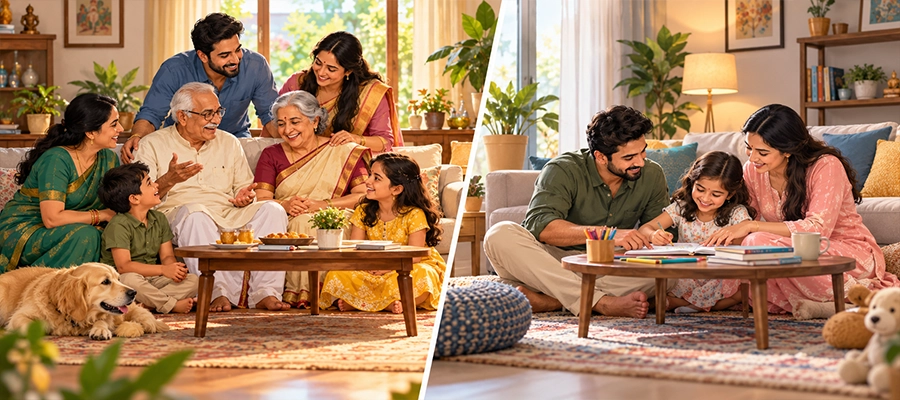

A psychological perspective on connection, autonomy, boundaries and emotional well-being
For generations, the question has often been framed as a choice:
Joint family or nuclear family?
The joint family is praised for its togetherness, support and strong relationships. The nuclear family is praised for its independence, privacy and freedom.
One is sometimes described as too traditional. The other as too individualistic.
But psychology asks a different question:
What happens to us psychologically within these family structures?
Because the number of people living under one roof does not determine whether a family is psychologically healthy.
A person can feel deeply lonely in a house full of people.
And someone can feel deeply connected despite living in a family of three.
The difference often lies not in the structure of the family, but in the quality of relationships within it.
Family is not just a living arrangement
From a psychological perspective, a family is a system of relationships.
Bowen Family Systems Theory conceptualises the family as an emotional unit in which members are interconnected and influence one another. A change in one person's emotional functioning can affect the functioning of others.
This means that when we ask whether a joint or nuclear family is better, we are actually asking something more complex:
How safe do people feel expressing themselves?
Can family members disagree without fearing rejection?
Are individual boundaries respected?
Is there emotional and practical support?
Can people make independent decisions?
Are responsibilities fairly distributed?
Is conflict addressed or simply avoided?
Do family members feel connected without feeling controlled?
These factors may matter far more for psychological well-being than the number of people in the household.
The Joint Family: The Psychology of “We”
One of the greatest strengths of a joint family can be its social and emotional connectedness.
There may be grandparents, siblings, cousins, uncles, aunts and other relatives available for conversation, caregiving and practical support.
A child may have multiple adults to turn to.
A parent may not have to carry every responsibility alone.
An older adult may have people around them throughout the day.
In times of illness, financial difficulty or emotional crisis, the family can function as a larger support network.
From a social psychological perspective, this can provide something humans fundamentally need: belonging.
We derive part of our sense of identity from the groups and relationships to which we belong. Family can provide continuity, identity, shared traditions and a sense of “these are my people.”
But there is another side to belonging.
Belonging becomes psychologically unhealthy when it requires the loss of individuality.
When “togetherness” becomes too much
In some families, closeness can gradually become over-involvement.
Concern can become monitoring.
Advice can become control.
Respect for elders can become unquestioned obedience.
Family involvement can become interference.
And togetherness can become the inability to say: “This is my decision.”
This is where Bowen's concept of differentiation of self becomes particularly useful.
Differentiation refers broadly to the ability to remain emotionally connected to others while maintaining one's own thinking, identity and boundaries.
In simple terms:
Healthy connection does not require emotional fusion.
A person can love their parents and still disagree with them.
A daughter-in-law can respect her in-laws and still have boundaries.
A young adult can remain close to their family while making independent career decisions.
A parent can be involved in their child's life without deciding every aspect of it.
The psychological goal is not distance. It is connected autonomy.
The Nuclear Family: The Psychology of “We, but also Me”
The nuclear family can offer something equally important: space.
Fewer people may mean greater privacy, more independence in decision-making and clearer boundaries around parenting, finances, routines and relationships.
For some individuals, this can support autonomy, self-expression, privacy, personal decision-making and flexibility.
A young couple may have greater freedom to establish their own routines.
Parents may have more control over how they raise their children.
Children may experience fewer competing expectations from different adults.
But independence also comes with a psychological cost.
When independence becomes isolation
The same privacy that feels liberating to one person can feel lonely to another.
In a nuclear family, there may be fewer people available to share childcare, household responsibilities, emotional stress, financial difficulties, illness and everyday companionship.
Parents may experience greater pressure because much of the caregiving responsibility falls on one or two people.
An older adult living separately from their children may experience loneliness.
A child may have fewer opportunities for spontaneous interaction with grandparents, cousins or extended family.
And when conflict occurs within a nuclear family, there may be fewer people around to absorb some of the emotional or practical pressure.
So the nuclear family can provide autonomy without necessarily providing connection.
And autonomy without connection can sometimes become isolation.
What Family Systems Theory teaches us
Structural Family Therapy, associated with Salvador Minuchin, looks at families through concepts such as boundaries, subsystems, hierarchy and patterns of interaction.
This gives us an important insight:
The problem is not whether boundaries exist. The problem is whether they are too rigid or too diffuse.
A family with extremely rigid boundaries may look like: “Everyone handles their own problems.” There may be independence, but very little emotional support.
A family with extremely diffuse boundaries may look like: “Everyone has a say in everyone's life.” There may be connection, but very little privacy or autonomy.
Psychologically healthy families tend to have flexible boundaries.
They allow: “I am my own person, and I am still part of this family.”
The Attachment Perspective: We Need Both Security and Independence
Attachment theories bring another important dimension to this discussion.
Human beings have a fundamental need for secure relationships—relationships in which they can seek comfort, feel understood and experience emotional safety.
But healthy development also involves exploration and increasing independence.
This creates an apparent contradiction:
We need people, and we need ourselves.
A psychologically healthy family allows both.
A child should know: “I can come back to you when I need you.”
And also: “I can go out into the world and become myself.”
The same principle applies to adults.
A healthy family provides a secure base, not a permanent cage.
Emotionally Focused approaches similarly emphasize that family distress can be understood through attachment and relational needs, particularly the need for safety, accessibility, connection and secure bonds.
This means that family conflict is not always simply about who is right.
Sometimes underneath “You never listen to me” is “Do I matter to you?”
Under “You don't need us anymore” may be “Are we still important to you?”
And under “Stop interfering in my life” may be “I need you to trust that I can handle my life.”
The Social Psychology of Family Expectations
Family is also a social group.
And every social group has norms.
In collectivistic cultures such as India, family identity and interdependence can carry significant psychological value. But strong group norms can also create pressure to conform.
This is where statements such as “What will people say?”, “Everyone in the family does it,” “You should adjust,” and “We are family; you cannot say no” become psychologically important.
The desire to belong can sometimes make people suppress their preferences.
A person may choose a career to satisfy the family.
A couple may struggle to establish boundaries because saying no is interpreted as disrespect.
A child may learn that disagreement equals disobedience.
An adult may experience guilt simply for wanting something different.
The question therefore becomes:
Is family teaching me that I belong because I am loved—or because I conform?
There is a profound psychological difference between the two.
The Invisible Emotional Roles We Take On
Families also develop patterns.
One child becomes the “responsible one.”
Another becomes the “problem child.”
Someone becomes the mediator.
Someone becomes the emotional caretaker.
Someone learns to remain silent to keep the peace.
Bowen's family systems framework draws attention to processes such as triangles, family projection and multigenerational transmission—ways in which anxiety and relational patterns can become organised within families and sometimes continue across generations.
This is why family structure alone cannot explain psychological outcomes.
Two joint families can look identical from the outside. Inside, one may be warm, flexible and emotionally safe. The other may be characterised by criticism, comparison and chronic tension.
Likewise, two nuclear families can look identical. One may provide security and emotional openness. The other may be emotionally disconnected.
Perhaps the Most Important Factor: How Does the Family Handle Conflict?
Conflict is inevitable in families.
Different generations will have different values.
Partners will disagree.
Parents and children will clash.
Siblings will compete.
The presence of conflict does not automatically mean a family is unhealthy.
What matters is what happens after the conflict.
Can someone say “I disagree with you” without being labelled disrespectful?
Can someone say “That hurt me” without being dismissed?
Can parents apologise to their children?
Can adult children say no without being punished emotionally?
Can couples disagree without forcing other family members to take sides?
Can family members repair relationships after conflict?
Emotionally focused perspectives look at the underlying attachment needs and negative interaction cycles that keep families stuck.
The goal is not to eliminate conflict.
It is to create relationships in which conflict does not threaten the relationship itself.
So, Which Family Is Better?
Perhaps the most honest psychological answer is: Neither.
Or more accurately: It depends.
A joint family can provide connection but become intrusive.
A nuclear family can provide autonomy but become isolating.
A joint family can distribute responsibilities but also distribute opinions.
A nuclear family can simplify boundaries but concentrate responsibilities.
The same structure can be protective in one family and stressful in another.
An Indian comparative study conducted in Ahmedabad found no significant difference in psychological well-being between people from joint and nuclear families. This supports the idea that simply categorising people by family structure tells us very little about their actual psychological well-being.
Emerging Indian research continues to examine how family structure interacts with variables such as loneliness, conformity, self-efficacy, psychological distancing and affiliation rather than treating joint and nuclear as inherently good or bad categories.
Maybe We Are Asking the Wrong Question
Instead of asking: “Joint or nuclear?”
perhaps we should ask:
“What kind of family are we creating?”
A psychologically healthy family allows you to experience:
Connection without control.
Independence without isolation.
Support without dependency.
Respect without fear.
Tradition without forced conformity.
Boundaries without emotional cutoff.
Closeness without losing yourself.
That may be the real goal.
Because ultimately, psychological well-being does not come from simply having more people around us—or fewer.
It comes from knowing:
I have people I can turn to.
I can be myself with them.
I can disagree with them.
I can grow beyond them.
And I don't have to choose between belonging and being myself.
Perhaps the healthiest family is not the one that lives under one roof.
It is the one where there is enough connection to feel that you belong, and enough psychological space to become who you are.
Selected theoretical references and evidence
Bowen Center for the Study of the Family. Introduction to the Eight Concepts.
https://www.thebowencenter.org/introduction-eight-concepts
Minuchin, S. Structural Family Therapy framework: boundaries, subsystems and hierarchy.
Emotionally Focused Family Therapy: attachment-based understanding of relational distress.
Indian comparative research on psychological well-being among joint and nuclear families (Ahmedabad):
https://ijip.in/articles/the-psychological-well-being-among-joint-and-nuclear-families-a-comparative-study/
Recent Indian research examining family structure alongside loneliness, conformity, self-efficacy, psychological distancing and affiliation: https://pubmed.ncbi.nlm.nih.gov/40790742/