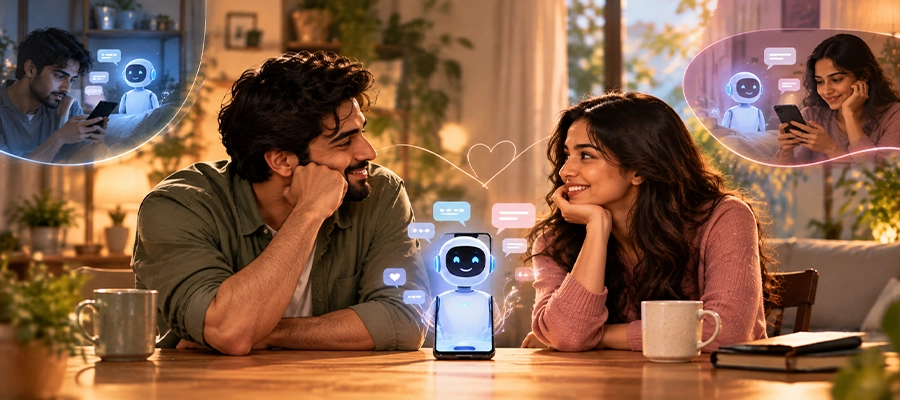

We have always found ways to connect. Letters became phone calls, phone calls became video calls, and conversations that once required two people to be in the same room can now happen across continents in seconds. But artificial intelligence is introducing something different. For the first time, we are not simply using technology to communicate with another person. We can now have conversations with something that responds to us, remembers what we tell it, adapts to the way we speak, and is available whenever we want it. This raises an uncomfortable but fascinating question: if technology can give us some of the experiences we usually seek from relationships, will it change the way we form relationships with other people?
Consider something quite ordinary. You have had a difficult day. You don't necessarily want advice, and you don't want someone to tell you that you're overreacting. You just want to talk. You open an AI chatbot and start typing. It doesn't get irritated because you're repeating yourself. It doesn't interrupt. It doesn't have a bad day of its own. It is available at 2 a.m. and responds within seconds.
You might even begin to feel understood. There is something psychologically powerful about that experience, even when we know the other side isn't human.
Human relationships, however, have never been built only on being heard. They are also built on unpredictability, compromise, disagreement, repair and mutual vulnerability. A friend may misunderstand you. A partner may be distracted when you need them. A parent may not always respond in the way you hoped. These experiences can be frustrating, but they are also part of learning how to relate to another human being. Relationships require us to negotiate two separate minds, not simply interact with something designed to respond to us.
This is where AI could change our expectations. Imagine getting used to a conversational partner that is endlessly patient, available on demand and highly responsive to your preferences. Real people cannot compete with that level of availability. They have work, families, moods, boundaries and needs of their own. If we become accustomed to relationships that involve very little rejection, waiting or misunderstanding, ordinary human relationships may begin to feel unusually difficult. The problem may not be that AI replaces people. It may be that our tolerance for the ordinary difficulties of being with people changes.
At the same time, it would be too simplistic to assume that every connection with AI is unhealthy. Human beings have always used objects, stories and technology to process emotions. People write in diaries, talk to themselves, rehearse difficult conversations, write letters they never send and seek anonymous support online. An AI conversation can sometimes serve a similar function. Someone who is lonely might use it to organise their thoughts before reaching out to a friend. Someone who struggles socially might practise a difficult conversation. Someone who feels embarrassed discussing a problem may find it easier to put their thoughts into words first.
There is also something particularly interesting about the way our minds respond to responsiveness. We tend to attribute human qualities to things that communicate with us. We name our cars, talk to pets as though they understand every word, and sometimes become emotionally attached to fictional characters. When something responds appropriately to our emotions, remembers details about us and communicates in a conversational way, our brains don't necessarily treat the interaction as meaningless simply because we know it is artificial. We can intellectually know that there is no human being on the other side and still experience the interaction emotionally.
This becomes even more complicated when AI is used as a substitute rather than a supplement to human connection. Imagine someone who repeatedly feels rejected by other people. An AI companion may offer a space where rejection is absent. That can feel comforting. But if every uncomfortable interaction with a real person is replaced by an easier interaction with AI, the person may get less opportunity to practise the very skills needed for human relationships: communicating needs, tolerating disagreement, setting boundaries, apologising, repairing misunderstandings and accepting that another person may not always respond exactly as we want.
There is another side to this conversation that is easy to overlook. Human relationships are not valuable because they are efficient. In fact, much of their meaning comes from the opposite. Someone remembers your coffee order. A friend calls without being asked. Your partner notices that something is wrong even though you say you're fine. Someone sits beside you without knowing what to say. These moments are meaningful partly because another human being has chosen to show up for you. There is intention, effort and mutuality involved.
AI may therefore change relationships not simply by replacing certain interactions, but by changing what we expect from them. We may begin to expect immediate responses, constant emotional availability and personalised attention. We may become less patient with silence, disagreement or emotional complexity. At the same time, AI could also make some people more aware of what they need from relationships by giving them a space to articulate those needs.
Perhaps the more important question is not whether AI will replace human relationships. It is whether we will start designing our human relationships around what machines can provide. A machine can respond whenever we want. A person cannot. A machine can be available without needing anything from us. A person has needs of their own. A machine can be customised to suit us. A person remains wonderfully, sometimes inconveniently, different from us.
And that difference may be precisely what makes human relationships psychologically important. Healthy relationships require us to encounter another person as a separate individual, not as an extension of ourselves. They teach us that we can be misunderstood and still explain ourselves, disappointed and still remain connected, angry and still repair, vulnerable and still be accepted. They expose us to perspectives we didn't choose and emotions we cannot control. AI may be able to imitate some of these experiences, but human relationships give us something fundamentally different: another human being who has their own inner world.
So yes, AI may change how we form relationships. It may change how we meet people, communicate, seek reassurance, practise conversations and cope with loneliness. It may even become part of people's emotional lives in ways we are only beginning to understand. But perhaps the goal should not be to make human relationships as convenient as AI interactions. Perhaps it is to use AI without forgetting why human connection was valuable in the first place.
Because at the end of the day, being understood by a machine may feel comforting. But being understood by another human being, who is free to disagree with you, misunderstand you, walk away, come back, choose you and be changed by knowing you that is a very different kind of connection.