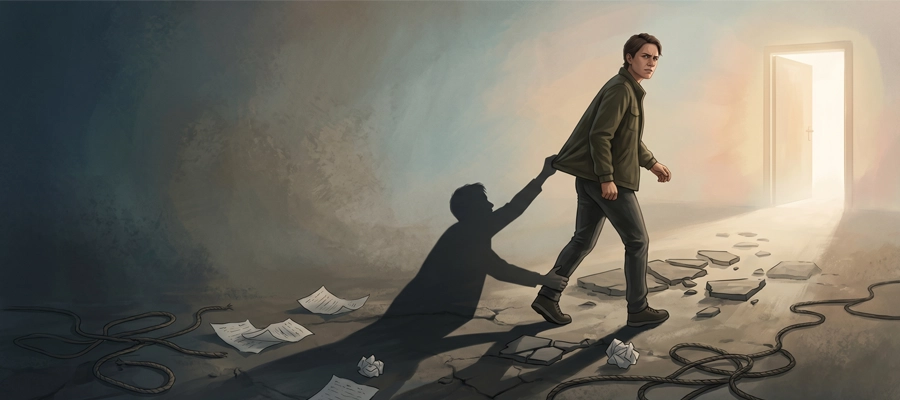

Have you ever waited until the last minute to start an important task, even when you knew it would create stress later? Have you ever pushed away someone you deeply cared about because you were scared of getting hurt? Or maybe you have found yourself thinking, "I want this so badly," and yet somehow doing things that take you further away from it. Many people believe self-sabotage means laziness, lack of willpower, or not wanting success badly enough. But psychology suggests something very different. Self-sabotage is often not about wanting to fail. Sometimes, it is the mind trying to protect itself.
That sounds strange because why would anyone protect themselves by creating problems?
Our brains are designed for safety more than happiness. From an evolutionary perspective, survival has always been the priority. The brain constantly asks questions such as: Is this safe? Is this familiar? Could this hurt me? Notice that the word is familiar, not necessarily good. Sometimes people stay in situations that make them unhappy simply because those situations feel predictable. Even stress can become familiar. Even self-doubt can become familiar. Imagine someone who grew up hearing things like, "You're not good enough," or "Don't make mistakes." Years later, as an adult, they may get an opportunity at work, enter a healthy relationship, or move closer to a goal they always wanted. Logically they may feel excited. But another part of them may quietly think: "What if I fail? "What if I disappoint people?" "What if I am not capable enough?"
Without realizing it, they may procrastinate, avoid opportunities, overthink decisions, or give up too quickly. Not because they want failure. Because failure feels less painful than proving their deepest fear true.
Psychological research has shown that people often engage in behaviors that create excuses or protective barriers before important situations. This process is called self-handicapping. For example, a student may avoid studying before an exam and later say, "I didn't really prepare." On the surface, it may look careless. But underneath, it can work like emotional protection. If the result is poor, it hurts less to believe "I failed because I didn't prepare" rather than "I failed because I wasn't good enough."
The mind sometimes chooses temporary emotional safety over long-term growth.
Self-sabotage can also appear in small ways that people do not always recognize.
It may look like:
- Waiting for the "perfect time" that never arrives
- Overthinking every decision
- Starting something and quitting midway
- Avoiding difficult conversations
- Staying in unhealthy relationships
- Constantly comparing yourself with others
- Believing you need to be fully ready before taking action
The difficult part is that self-sabotage rarely announces itself. It does not say, "Hello, I am here to ruin your life." Instead, it sounds reasonable.
"I'll start tomorrow."
"Maybe I need more time."
"What if things go wrong?"
"I am probably not ready."
Because these thoughts feel logical, people often do not notice the pattern.
Research in neuroscience also suggests that the brain prefers predictability. Familiar patterns require less mental energy. Change, uncertainty, and growth often activate stress responses because the brain interprets unfamiliar situations as possible threats. This is why people sometimes feel anxious even when positive things happen. A promotion can create anxiety. A healthy relationship can create anxiety. Success itself can create anxiety. Not because these things are bad, but because they are new.
The important thing to understand is that self-sabotage is usually not evidence of
weakness.
Very often, it is evidence of fear, old beliefs, or protective strategies that once made
sense.
A child who learned that mistakes lead to criticism may become an adult who fears
trying.
A person who experienced rejection may begin avoiding closeness.
Someone who felt valued only when performing well may struggle to rest without guilt.
The mind learns patterns and repeats them, even long after the original situation has
ended.
The good news is that patterns can change. Awareness is often the first step.
The next time you find yourself delaying something important, avoiding an opportunity, or stepping away from something meaningful, pause and ask: "What am I protecting myself from?"
Because sometimes the problem is not a lack of motivation.Sometimes the mind is trying very hard to keep a person safe And sometimes growth begins when people realize that safety and comfort are not always the same thing.