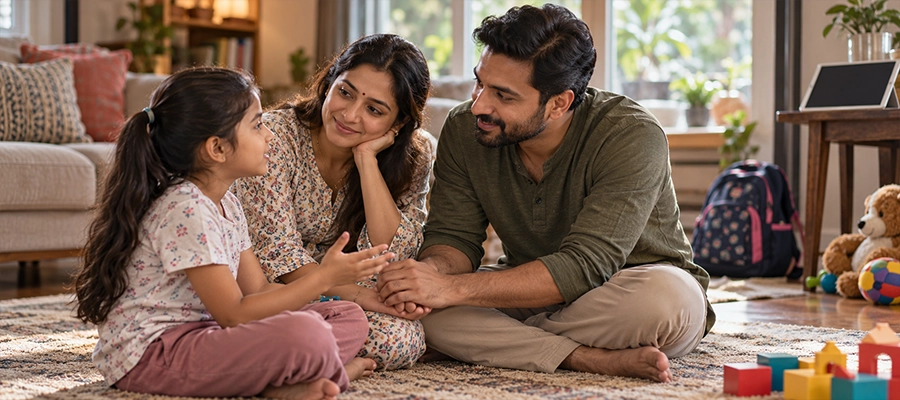

Today, parents do a great deal for their children. They strive to provide the best schools, expensive gadgets, extracurricular activities, comfortable lifestyles, and every opportunity they believe will help their children build a better future.
Behind these efforts are years of hard work, personal sacrifices, and a genuine desire to give children everything their parents may not have had growing up. Their intentions are good. They want their children to have a better life, fewer struggles, and more opportunities.
But somewhere along the way, an important question deserves our attention:
Are we so busy providing our children with everything they need that we are forgetting to give them something they need just as much our emotional presence?
A child may have the latest smartphone, but can they tell their parents when they have had a difficult day at school? They may have their own beautiful bedroom, toys, classes, and every material comfort, but when they feel hurt, rejected, or overwhelmed, do they have someone who will listen without judging them?
Sometimes, children receive almost everything they ask for, yet still struggle to receive what they emotionally need: their parents' time, patience, understanding, and the reassurance that they can express themselves without fear.
When a child is upset, we often rush to fix the problem. When they are sad, we tell them there is nothing to be sad about. When they become angry, we may scold them. And when they share a difficulty, we sometimes respond by saying, "We do so much for you, and you are still unhappy!"
But have we ever stopped to consider that, in that moment, the child might need understanding before advice?
Children do not always need solutions. Sometimes, they simply need someone to listen and say, "I can understand why that hurt you. Tell me what happened."
It may seem like a small response, but it can make a meaningful difference in how a child experiences the relationship with their parents.
Davidov and Joan E. Grusec, published in Child Development, examined the relationships between parental responsiveness and children's socio-emotional outcomes. The researchers found associations between parental responsiveness to children's distress and better emotion regulation. The study highlights why recognising children's emotional needs and responding supportively during difficult moments matter.
Similarly, the American Academy of Pediatrics' 2007 clinical report, The Importance of Play in Promoting Healthy Child Development and Maintaining Strong Parent-Child Bonds, emphasised the role of play in children's development and in strengthening parent-child relationships.
This does not mean parents must spend every waking hour with their children or fulfil every demand. Sometimes, even 15-20 minutes of meaningful interaction can be valuable when parents put their phones aside, listen attentively, or participate in an activity their child enjoys.
Children do not need perfect parents. They need parents they can approach when life feels difficult.
Another essential part of parenting is teaching children how to handle life's challenges. Because we do not want to see our children suffer, we sometimes try to solve every problem for them. We protect them from disappointment, shield them from the consequences of their mistakes, and make decisions on their behalf.
But life will not always provide someone to solve every problem for them.
Children need opportunities not only to learn and succeed but also to experience disappointment, tolerate frustration, take responsibility for their mistakes, and ask for help when necessary.
This does not mean being harsh or insensitive. Parents can acknowledge their children's feelings while maintaining appropriate boundaries. They can understand a child's disappointment while encouraging them to fulfil their responsibilities.
Love does not always mean removing every difficulty from a child's life. Sometimes, love means standing beside them while they learn to face those difficulties themselves.
Parenting also requires parents to understand their own emotional needs. Work pressure, financial responsibilities, exhaustion, and everyday stress can affect patience. Parents sometimes become irritated, raise their voices, and later feel guilty about how they reacted.
Instead of constantly blaming themselves, parents can learn to recognise their triggers and respond more thoughtfully. Admitting a mistake and apologising to a child does not weaken parental authority. It teaches children that mistakes are a normal part of relationships and that taking responsibility and repairing the relationship are equally important.
If parents feel that they are doing everything for their children but are still experiencing a growing communication gap, frequent conflicts, or emotional withdrawal, seeking professional support can be helpful.
Psychologists can help parents understand their children's emotional needs, improve communication, establish healthy boundaries, and develop positive parenting strategies. When appropriate, psychologists can also work directly with children to help them understand and regulate their emotions and cope with difficult situations.
Counselling does not mean that parents have failed. Sometimes, an objective perspective from a trained professional can help families understand one another better and build healthier relationships.
Perhaps every parent should occasionally ask themselves a simple question:
Am I only trying to create a better life for my child, or am I also becoming someone my child can turn to when life becomes difficult?
As children grow older, they may remember the facilities their parents provided and the opportunities they received. But they may also remember whether their parents listened when they were upset, whether they felt understood when they failed, and whether their parents were emotionally available when they needed them most.
Facilities can make a child's life more comfortable. Love, time, understanding, and emotional support can help a child feel that they do not have to face life alone.
The real meaning of parenting is not simply to arrange a better future for our children. It is also to build a relationship in the present one in which they can understand themselves, learn from their difficulties, express their feelings, and approach their parents without fear and perhaps that is one of the most valuable gifts we can ever give them.
References
- Davidov, M., & Grusec, J. E. (2006). Untangling the links of parental responsiveness to distress and warmth to child outcomes. Child Development, 77(1), 44–58. https://doi.org/10.1111/j.1467-8624.2006.00855.x
- Ginsburg, K. R., & American Academy of Pediatrics. (2007). The importance of play in promoting healthy child development and maintaining strong parent-child bonds. Pediatrics, 119(1), 182–191. https://doi.org/10.1542/peds.2006-2697
- Harvard University, Center on the Developing Child. A Guide to Serve & Return. https://developingchild.harvard.edu/resource-guides/guide-to-serve-and-return